Perashat Naso
By William Lebovics · 2026-05-29
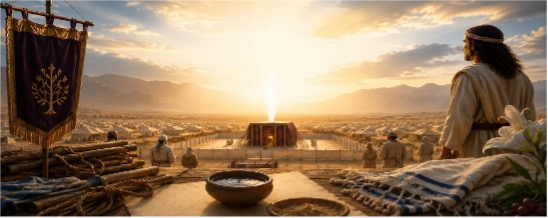
Parashat Naso begins with the counting of the families of Levi: Gershon, Kehat, and Merari. At first glance, it appears to be a simple census. Yet the Chatam Sofer reveals that these three sons of Levi represent three different stages in Jewish history and three different spiritual realities.
Kehat represents the Jewish people at their highest point. The Beit HaMikdash stands, the Divine Presence rests among us, and Torah occupies the center of national life. It is no surprise that Kehat is counted first, despite not being the oldest son, because his family carried the Aron, the Ark that housed the Torah itself. When a person carries Torah, Torah elevates them.
Gershon represents a different reality: galut. His very name comes from the idea of being driven out and exiled. Yet Gershon's children, Livni and Shimi, hint at hope. Livni represents purification and teshuvah. Shimi represents listening. Even in exile, a nation can find its way home by cleansing itself and listening once again to the voice of Hashem.
Then comes Merari. His name is rooted in marirut, bitterness. Merari represents a generation living in a darkness so deep that even the path back seems unclear. We want to listen, but often do not know who to listen to. We want to grow, but feel overwhelmed. The children of Merari are named Machli and Mushi, names associated with sickness and distance. It is a portrait that feels surprisingly familiar.
Yet it is precisely here that the Chatam Sofer delivers an extraordinary message of encouragement.
When the Torah counts Kehat and Gershon, it uses the phrase "Naso et rosh" — "lift up their heads." But when Merari is counted, that phrase is absent. Why?
The Chatam Sofer explains that Merari does not need to be lifted. The spiritual value of the mitzvot performed in times of darkness is already so great that no additional elevation
is necessary. Every act of growth, every prayer, every step toward holiness taken under difficult circumstances carries immeasurable weight in the eyes of Hashem.
The earlier generations accomplished incredible things. Their faith, resilience, and dedication were remarkable. Yet we must never underestimate the significance of what can be achieved in our own generation. A person struggling to keep Shabbat, to pray, to learn, or simply to move one step closer to Hashem may be accomplishing far more than they realize.
Perhaps this is why the names Machli and Mushi can also be understood differently. Mushi can mean simply to move. Machli can hint to taking something ordinary and infusing it with holiness. Hashem is not necessarily asking for dramatic transformations. Sometimes He is asking only for movement. One small step. One small improvement. One small act of growth.
Neil Armstrong famously said, "One small step for man, one giant leap for mankind." On the moon, where gravity is weaker, even a small step carries a person much farther than expected.
The same is true spirituall